


From4:00 PM
To4:05 PM
GMT
Tags:
Opening / Closing
Welcome & Community Updates
+ Read More
Speakers:




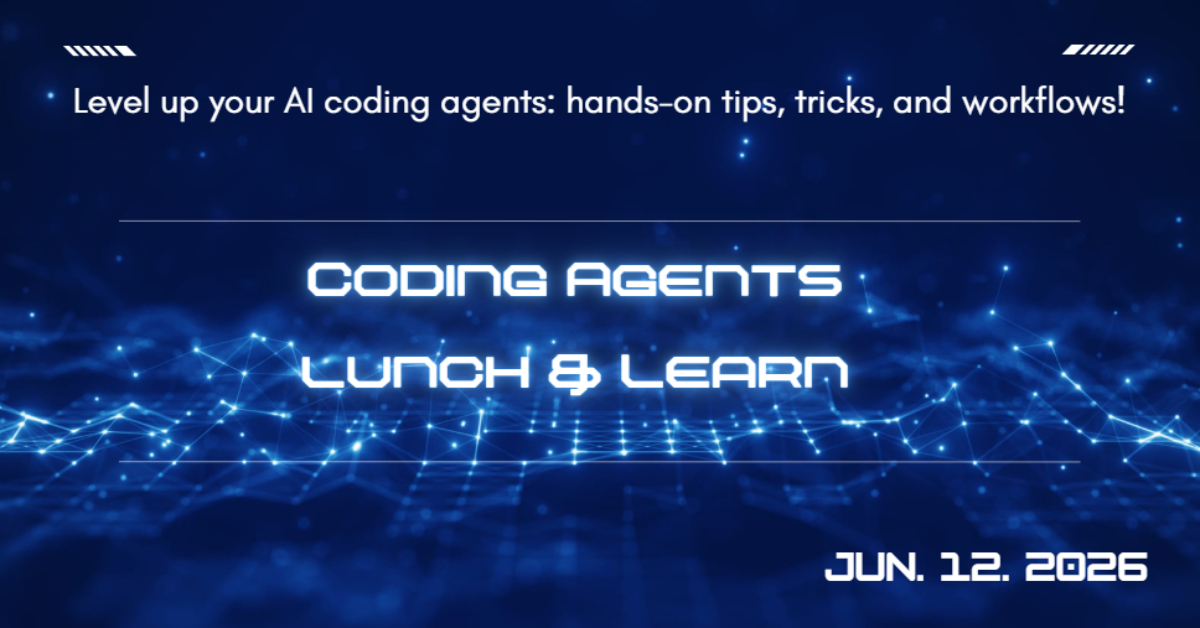
Join us for Session 15 of the Coding Agents Lunch & Learn, our weekly community series exploring the tools, workflows, frameworks, and real-world applications shaping the future of AI coding agents.
This week, we're exploring one of the most important challenges in agent engineering: how to build AI systems that can retain knowledge, maintain context, and scale without exploding inference costs.
As agent workflows become more complex, teams are running into the limits of today's architectures. Agents repeatedly reread documents, lose important context, struggle with long-running tasks, and consume increasingly expensive amounts of tokens to maintain performance. While larger context windows have helped, they haven't solved the fundamental problem of how AI systems store, share, and build upon knowledge over time.
For this session, we're joined by Devansh, Head of AI at Iqidis and creator of Stateful Swarms, an open-source architectural paradigm designed to make agent systems more intelligent, cost-efficient, and auditable.
Instead of forcing agents to repeatedly recompute information and pack everything into ever-growing context windows, Stateful Swarms introduce a persistent, structured memory layer powered by a coordinated blackboard system. Specialized agents collaborate through a shared knowledge base, preserving important discoveries, reducing context loss, and enabling information to be reused across iterations. The result is a more scalable approach to agent engineering that improves reliability while dramatically reducing the cost of execution.
During the session, Devansh will walk through the design principles behind Stateful Swarms, why persistent memory may be the missing layer in modern agent systems, and how this approach can dramatically improve both performance and cost efficiency. He'll also share benchmark results from Harvey AI's Legal Agent Benchmark, where Stateful Swarms achieved an 83.74% pooled criteria pass rate and a 17.75% strict all-pass rate at a fraction of the cost of previously published approaches.
Through a live walkthrough and technical deep dive, we'll explore:
• Why context windows and token costs are becoming major bottlenecks for AI agents• Persistent memory architectures and structured knowledge systems• Blackboard-based coordination for multi-agent workflows• Reducing recomputation and preventing context loss across complex tasks• Building more auditable and observable agent systems• Open-source tooling and implementation details behind Stateful Swarms• Lessons learned from benchmarking and real-world agent deployments
We'll also discuss the broader shift toward stateful agents, why memory and context management have become foundational challenges in agent engineering, and how the wider Agentic AI Foundation ecosystem is helping shape the next generation of agent infrastructure.
Whether you're building coding agents, autonomous workflows, AI copilots, or next-generation agent infrastructure, this session will provide practical insights into how persistent memory and stateful architectures could reshape the future of agent engineering.