

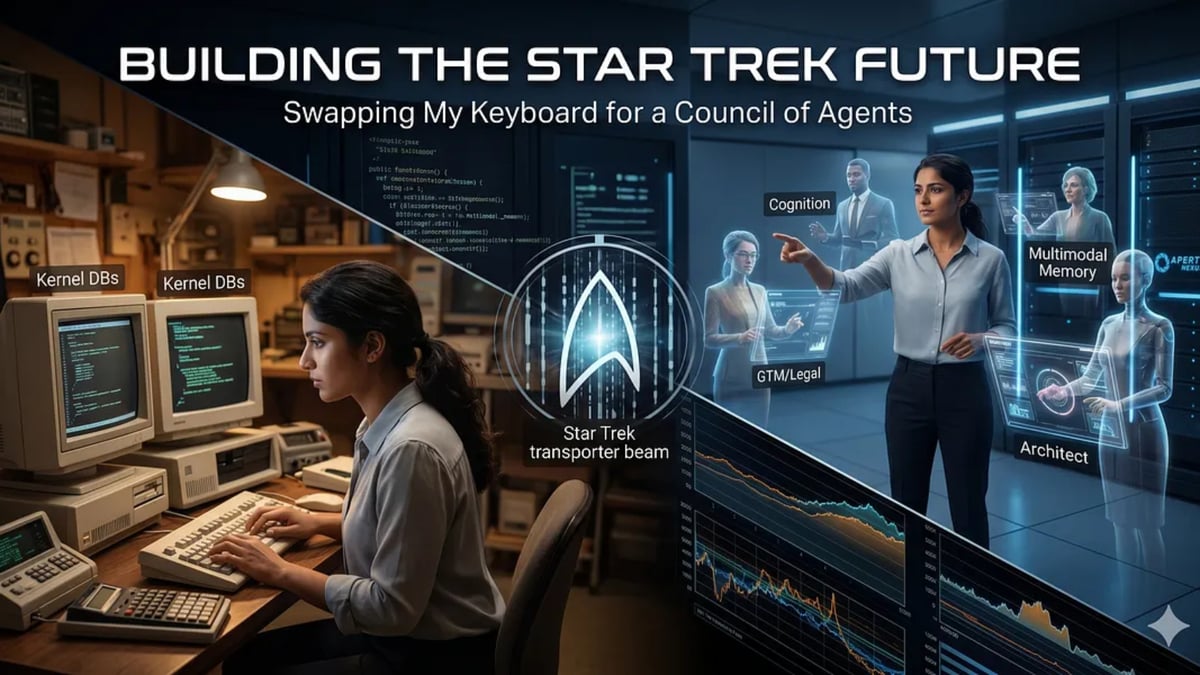
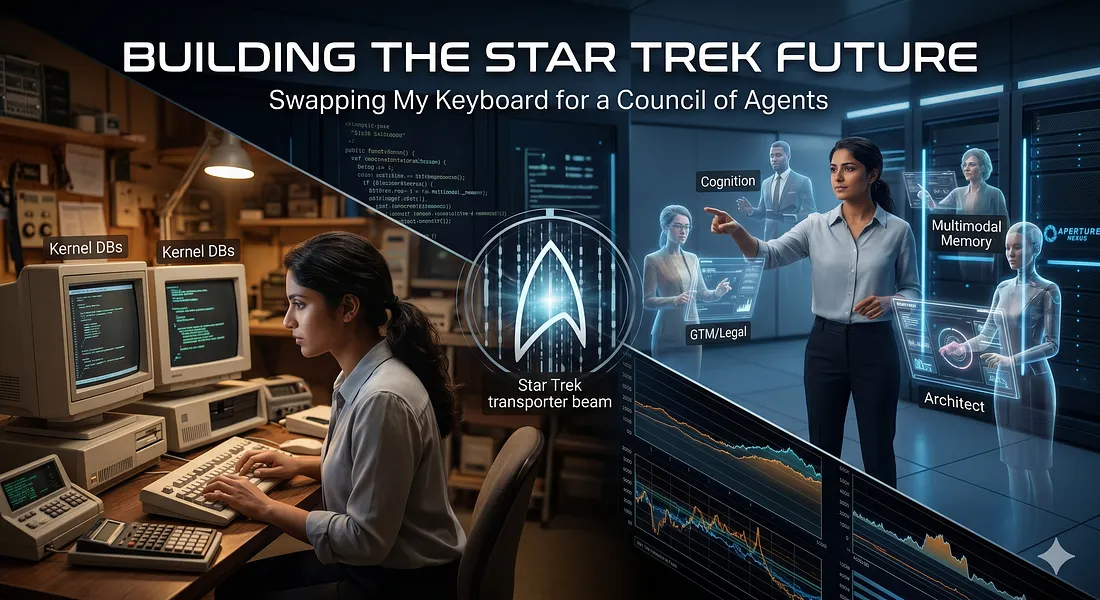
Building the Star Trek Future: Why I Swapped My Keyboard for a Council of Agents
# AI Agents in Action
# Cognition
# Founders
From Writing Code to Orchestrating Intent: How AI Agents Shifted My Role from Builder to Conductor.
June 30, 2026
Vishakha Gupta
My first instinct when the AI wave hit? Denial. I am the person who had to make sure I could still “code it by hand” just to prove my brain hadn’t rotted. I’ve always applauded the people who can just hop into a Waymo and trust the sensors, but I’m not there yet. For me, trust is a journey of acceptance. I’ve reached it with automated trains and autopilot in planes, systems where the parameters are tight and the logic is proven. I am the skeptic who doesn’t let Tesla do FSD unless we are on highways, having seen enough bugs in my career to know exactly what can go wrong.
And for AI agents and chatbots? I have to run the tests myself. That is an important distinction — there is a massive psychological difference between a “closed loop” automated train on a track and the “open chaos” of a Waymo on a city street. It perfectly reinforces the point: Trust is a journey, not a switch.
From C++ to Claude: Why I Stopped Worrying About My “Coding Brain”
If you told me three years ago that I’d be ‘talking’ my code into existence, I would have told you that’s a recipe for leaky, un-debuggable systems.
However, after a front row seat to AI journey at ApertureData, and a recent multimodal hackathon, I’ve realized the nature of our profession has been changing for some time and now this pace of change due to AI is irreversible and accelerating weekly. With that came another realization, my ‘coding brain’ isn’t rotting, it’s actually getting a promotion! You might have experienced this too — you are driving or about to go to sleep at night, and finally realize how to build something or solve a problem but you cannot do so if you want to keep your brain alive. Well, not anymore, since you can issue commands to your agents and transfer that thought process for execution, voila, you have the first version when you get to your destination or wake up the next morning.
The “Kid in a Candy Store”
I felt the full weight of this shift at a recent multimodal hackathon. It was a pure “kid in a candy store” moment for me. In the old world, a hackathon project was a frantic race just to get a basic CRUD app running. Now? I watched engineers and founders building sophisticated, multimodal systems in hours, things that used to require entire specialized departments. Heck, I built a UI with Lovable in half an hour and I just could not think in terms of UI before!
I got so into this new reality that I started curating an agentic stack of the tools builders actually love. I moved from writing every line of code to orchestrating intent and making sure it was realized as I intended.
“Founder Mode” and the Age of Agents
There’s been a lot of talk about “Founder Mode”. Some think AI means founders can finally “tune out” the details. I believe the opposite is true.
Scale, security, and efficiency still require you to understand what is being built and how it is presented. You cannot “hang up the gig” just because you have a coding or a GTM agent. Instead, my and the team’s role has generally evolved into orchestrating a multi-disciplinary “Council” depending on our focus. We use Claude(tte) or Gemini to help architect complex technical frameworks like the one for AI memory and cognition, GitHub Copilot to find bugs and ship documentation updates in record time. On the business side, I lean on Gemini and Microsoft Copilot to research deep-tech market landscapes and help me draft personalized outreach to specific decision-makers where Aperture’s multimodal store solves their top-of-mind challenges. Gemini does a lot of heavy design lifting too these days. I’ve even used these agents to navigate the first pass of complex legal or tax questions and agreements.
Operators and founders cannot give up the deep oversight that ensures a system is production-ready. The cross between Customer Experience (CX), the human lens, and agentic speed requires experience to harness it. AI agents are simply the next evolution in our efficiency game, a journey we started with assemblers, then compilers, then high-level languages. Each step didn’t make jobs go away; it just allowed us to take on harder, more ambitious problems.
Vigilance, Not Laziness
Does automation make us lazy? It can. Should it have “beeps” that keep us involved? Absolutely.
I recently wrote memory code with Claude(tte) and tested it in an application written with Augment Code for a hackathon with my teammate. I still had to design the schema and know my requirements. The AI generated the code fast, but there were mistakes like out-of-place comments and untested logic. Because I understood the fundamentals, I could guide it. I could actually do a much better job of documentation and demo creation thanks to it. When we used it during the hackathon, Augment code quickly picked up how to use it and Claude(tte) could help fix as we discovered any bugs either through its own inspection or my prompts.
We aren’t losing our brains to the models; we’re finally getting the leverage we’ve always needed. We want our senior engineers to be 10x Architects who don’t have to stay up all night to finish a project on time or miss deadlines. We also no longer need to compromise on user experience for a complex infrastructure project. It’s a bright new world!
The Abundance of Representation
There is a specific benefit to this agentic shift that we don’t talk about enough, especially from a founder’s perspective. It’s about finding a sustainable balance for everyone. We are currently in a “mad rush,” but the end goal is to use this abundance of “representatives” to get our time back.
In the near future, taking a vacation shouldn’t mean dropping the ball or returning to a mountain of ignored context. If we build these stacks correctly, we can launch our agents in abundance to maintain our presence. It means we can finally move away from the “always-on” culture because our Council holds the fort, allowing us to find the life balance that the tech industry has punted for decades.
As a woman founder, I see this as an opportunity for some real biohacking — using AI to balance the uncompromising demands of a startup with the reality of human biology. For a lot of us, every month, there is an unavoidable period where the body suffers and the brain fogs up but you can’t just “drop everything”. What you can do is see the fog coming. The “Council of Agents” can now pick up the slack when the physical energy is low; they can help keep up with Slack, draft outreach, and keep the momentum going while the body gets the time it needs.
Attacking the Big Hairy Audacious Goals
By automating the drudgery like coding up test harnesses, we finally get to focus on the problems we were forced to ignore earlier. We are no longer stuck in the weeds of syntax; we are solving for who, why, and how we scale securely. We can solve the cost and resource problems.
When we operate this efficiently, we can finally attack the “Big Hairy Audacious Goals” (BHAGs). If we get a handle on this agentic layer, what’s stopping us from solving deep social impact issues or accelerating space travel? The evolution of our industry allows us to stop asking “how do I code this?” and start asking “is this system secure, is it efficient, and is it actually solving a human problem?” We can move toward a Star Trek future! How about we focus on finally building that transporter?
Why Nexus?
As I built this stack, I hit a wall. My “Council” is brilliant, but they all have amnesia. They didn’t talk to each other. I am the only one who remembers the context from yesterday and across agents.
This drove me deep into the world of AI cognition to find a solution, and when I couldn’t find one that met enterprise standards for shared, multimodal, contextual memory, well, Claude(tte) and I started building it.
We are building Aperture Nexus because the “Candy Store” is only fun if you can remember which treats you’ve already picked and prefer.
The Road Ahead
I’ll be the first to admit: there is still a massive amount of territory to be explored. Every day, I’m tuning my “Council”, refining my prompts, thinking about token efficiency, wrapping my head around the new pricing models, and getting my skills game up to match the pace of these models and harnesses (need to research that more!). Transitioning from a kernel debugger to an “intent orchestrator” is its own kind of steep learning curve, and I’m still very much in the middle of it.
But as I look at the stack we’ve built and the speed at which we’re now moving, I’m convinced the sky is the limit. Once we stop being slowed down by the friction of implementation — the parts of the job that keep us from reaching that ‘Commander Data’ level of instant, contextual execution — we can finally step into the future.
The build is just beginning…
Thank you, Sonam Gupta, for your feedback!
Dive in
Related
Blog
Securing AI Agents: The Future of MCP Authentication & Authorization
By Subham Kundu • Sep 2nd, 2025 • Views 809
Video
Future of Software, Agents in the Enterprise, and Inception Stage Company Building
By Eliot Durbin • Mar 4th, 2025 • Views 493
Blog
Securing AI Agents: The Future of MCP Authentication & Authorization
By Subham Kundu • Sep 2nd, 2025 • Views 809
Video
Future of Software, Agents in the Enterprise, and Inception Stage Company Building
By Eliot Durbin • Mar 4th, 2025 • Views 493